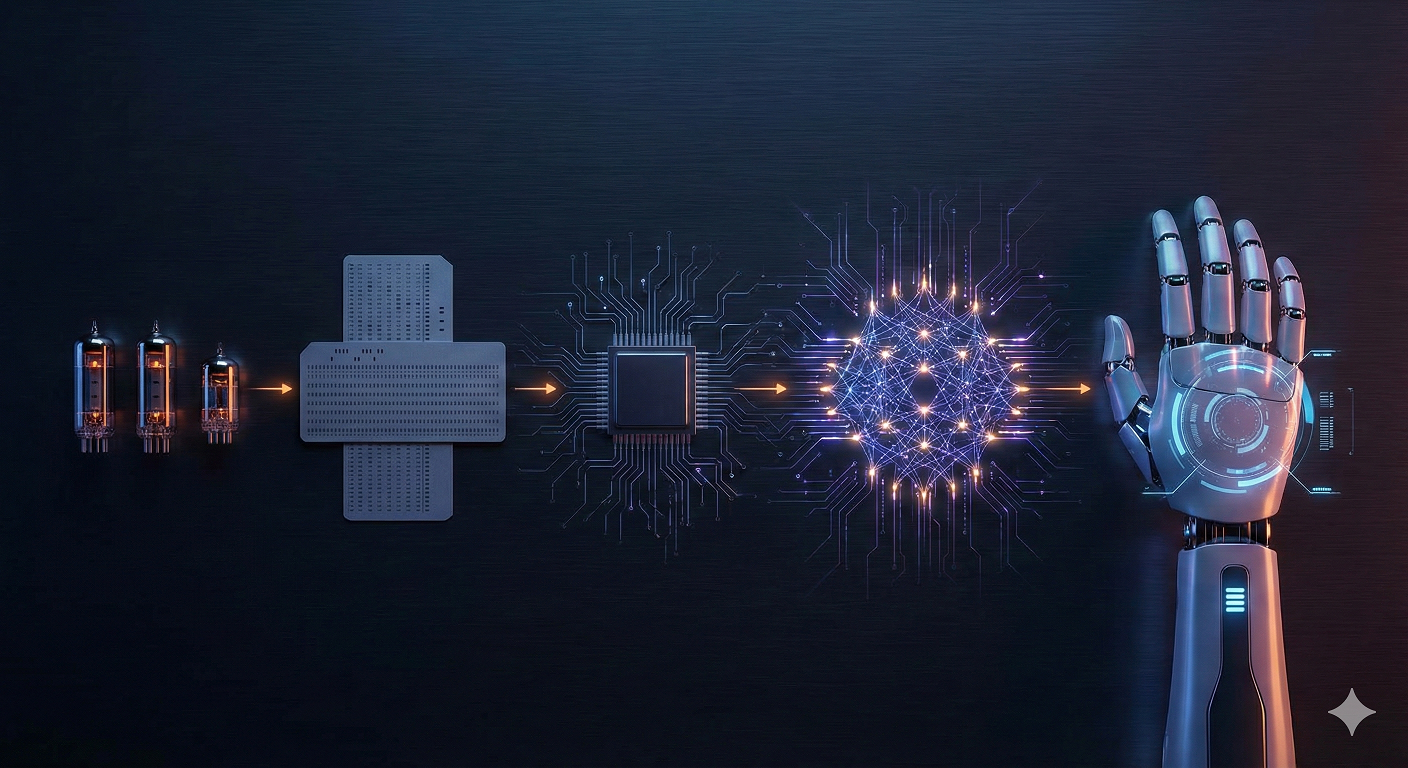
A Brief History of Artificial Intelligence: From the Turing Test to Agentic AI
March 2, 2026
Artificial Intelligence (AI) may feel like a brand-new technology, but the truth is it has been evolving for over 70 years. From simple math puzzles to today's powerful neural networks, each generation has built upon the foundation of the previous one.
Here is a tour of the historical milestones that have shaped the course of AI:
1950 - The Turing Test: Alan Turing, considered the father of computer science, proposed this test as the standard for measuring machine intelligence. If a human interacting through a keyboard could not tell whether they were talking to another person or a computer, the machine was considered "intelligent."
50s and 60s - LISP and ELIZA: During this time, LISP emerged as one of the first programming languages used for AI. Later, in the 60s, ELIZA was born, becoming the first "chatbot" in history. Although rudimentary, it simulated a psychologist and gave people their first sense of interacting with a system that understood them through natural language processing.
70s and 80s - Prolog and Expert Systems: The Prolog language introduced programming based on rules and logic. The 80s saw the rise of "expert systems," designed to learn certain rules and give advice in business contexts, although they ended up being somewhat rigid for the huge expectations of the time.
1997 - Deep Blue Makes History: IBM's Deep Blue system achieved what many thought impossible: defeating the world chess champion, Garry Kasparov. This event proved that a machine could surpass human planning, strategy, and creativity in a highly complex environment.
The 2000s - Machine Learning and Deep Learning: AI took a monumental turn. Instead of requiring humans to program every rule, systems began to learn by recognizing patterns on a massive scale (Machine Learning) and simulating human intelligence through neural networks (Deep Learning).
2011 - Watson Dominates Jeopardy!: IBM's Watson computer defeated the two greatest champions in the history of the trivia show Jeopardy!. The real achievement of this milestone was demonstrating that AI could understand natural language in all its complexity, including ambiguities, idioms, and figures of speech.
2022 - The Generative AI Boom: With the arrival of foundation models, we saw the rise of advanced chatbots capable of writing reports, summarizing documents, and generating images and sound. For most, this was the turning point where AI suddenly "got real."
2025 - The Year of Agentic AI: It's no longer just about generating content, but giving autonomy to systems. Agentic AI receives goals and uses different tools on its own to accomplish them from start to finish, operating as an independent assistant.
Where are we heading?
We are currently in the era of Artificial Narrow Intelligence, where systems are experts in specific tasks. The next big leap will be achieving Artificial General Intelligence, creating systems as smart as a human in any imaginable area. Eventually, we would reach Artificial Superintelligence, which will far exceed human cognitive capabilities on all fronts.
For decades, AI seemed like a distant dream moving at a snail's pace. Today, progress has taken off for the moon, proving we are just at the beginning of what this technology can achieve.
Blog

4 Keys to Mastering New Technologies Faster

The Future of BI: Smarter Business Intelligence with RAG & LLMs

AI Agents Best Practices: Monitoring, Governance, and Optimization
Start your Project
Tell us about your needs and how we can help you.