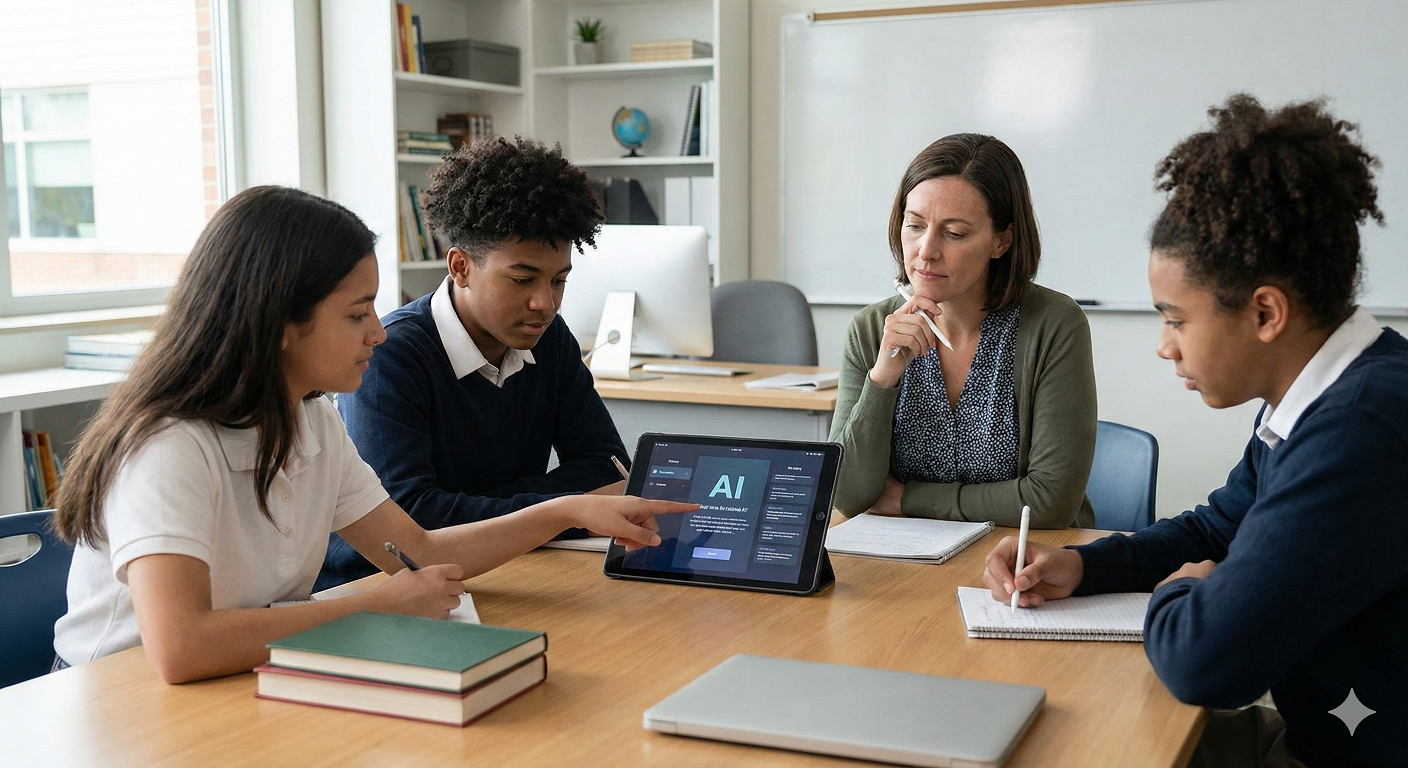
AI in the Classroom: Why We Must Teach Critical Thinking, Not Bans
February 11, 2026
Introduction When the first generative AI chatbots appeared, the immediate reaction from many educators was panic: "The essay is dead," they thought. If a bot can write it, what's the point of assigning it? The knee-jerk response from many institutions was to ban the technology to prevent students from cheating.
But, as IBM Technology points out, "the train has already left the station." Banning AI is like trying to stop a train by standing in front of it and yelling "Stop!" Instead of prohibiting it, the real challenge—and opportunity—lies in embracing this technology to elevate education to a new level.
The Evolution of "Essential Skills"
To understand why AI is not the enemy, we must look back. Historically, we spent years teaching skills that we now consider obsolete or secondary:
Penmanship (Cursive): This used to be a mandatory subject; today, most of our writing is done on computers and keyboards.
Memorization: Remembering the entire periodic table or exact dates was once vital. Today, that information lives in a database in our pocket. The focus now is on understanding the principles of chemistry, not memorizing atomic numbers.
Complex Arithmetic by Hand: We used to spend hours doing long division. Today, we use calculators to move quickly into calculus and algebra, where true logical analysis resides.
If the goal is to prepare students for the future job market, do we want them to be good at doing something a machine does better, or do we want them to master the tools they will actually use in their careers?
The New Skills: Critical Thinking Above All
In the AI era, the most valuable skills are shifting. It is no longer about executing repetitive tasks, but about cultivating a flexible and adaptable mindset. But above all, the reigning skill will be Critical Thinking.
AI can hallucinate, provide false data, or suggest things that are technically possible but ethically questionable. The human must be the judge. We must teach students to question: "Is this true? Is it useful? What are the unintended consequences of applying this solution?"
How AI Can Transform Education
Far from being a threat, AI offers pedagogical advantages that were previously impossible:
Personalized Tutoring: An AI tutor has infinite patience. It can explain a math concept in five different ways until the student understands it—something difficult for a teacher with 30 students to achieve.
Just-in-Time Education: If you need a refresher on a specific topic to move forward, AI provides it instantly.
Accessibility and Equity: Text-to-speech tools help students with disabilities. Furthermore, cloud-based AI democratizes access to high-quality educational resources for students who might not have access to the best physical schools.
The Teacher's Best Assistant: AI can help plan lessons, grade routine assignments, and act as a grammar "editor," freeing the teacher to focus on deep content and mentorship.
A Shift in Focus: From Essay to Debate
If take-home essays are no longer proof of learning, we change the method. The video suggests moving toward formats like live debate.
Students can use AI to research and prepare (acting as a research assistant), but in the moment of truth, they must defend their arguments in real-time, demonstrating mental agility and effective communication—skills they cannot delegate to a bot.
Conclusion
No boss in the future will say: "I want you to do this job, but please don't use AI." On the contrary, they will expect you to use the best tools available to stay competitive.
If we want to be responsible educators, we must teach how to use AI in the classroom today, so our students don't arrive in the future living in the past.
Blog
Why Most AI Projects Fail (and How to Ensure Yours Delivers Real ROI)
Agentic AI: The New Era of Automation
The AI Dictionary: Understanding Machine Learning, NLP, and Generative AI Subtitle
Start your Project
Tell us about your needs and how we can help you.